Stepping off the Shinkansen in Hiroshima I immediately thought I could feel radiation making my skin tingle.
I know the background radiation has dissipated (I googled it as soon as I got online in the hostel), but the psychology of arriving was so powerful I reacted physically.
Walking through the station all I could think about was the atomic bomb - that this station wasn't here, was that old lady here when it happened, that the whole city was essentially brand new.
It's weird coming to a city because it was destroyed in a war, but I had to come. I had to see it. Car-crash tourism.
I'm sure most of you can picture that wrecked building with the shattered, skeletal dome amid the broken wasteland of the former city? Wherever I saw that picture first I can't remember, but the image burned into my brain.
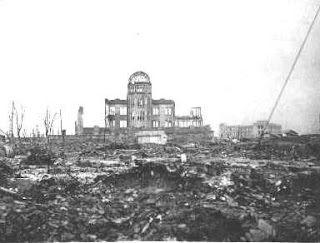
It used to be the Hiroshima Prefrectural Industrial Hall and, miraculously, was only about 400m from where the bomb detonated - although the bomb blew at a height of about 600m.
As we walked through downtown Hiroshima, all office blocks, busy roads, restaurants, bars and people, there it was.

Now called the Genbaku Dome, or Peace Dome, it's been left untouched on the banks of the river since the day the bomb went off.
It's hard not to be moved, but it's surrounded by so much modern urban vitality and a lovely river-side location that it's difficult to imagine what it must have been like in 1945.

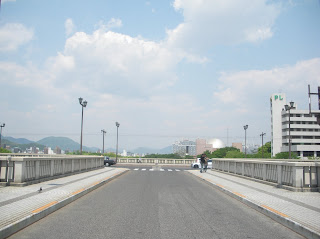
Next to the Peace Dome is the T-shaped bridge the bombardier on the Enola Gay used as a target. I think standing here was the spookiest of all - looking up into the blue sky and picturing the aircraft appearing through the clouds. Doesn't bear thinking about really. I wonder what that aircrew thought at the time they saw this bridge?
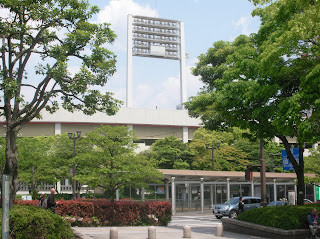
Weirdly, directly on the other side of the dome is a baseball park. The Japanese love their besu-beru, having it learned it from the Americans during the occupation after the war. But to build a shrine to their conquerors' national sport less than half a kilometre from ground zero? That's just perverse. Can you imagine the Americans putting a mosque on the site of the World Trade Centre?
Actually, perhaps they should.
On the other side of the river is the Peace Park, a little urban park filled with memorials to various groups of people killed by the bomb - Korean slave labourers etc - but the most moving is the kids' memorial.
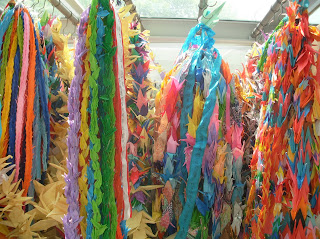
About half a dozen clear perspex boxes surround a statue to Hiroshima's children and inside each box are thousands and thousands of paper origami cranes. Apparently a young girl called Sadako Sasaki, who was two when the bomb went off, died of leukaemia ten years later and she became a symbol of peace for the city.
Heartbreakingly, as she lay dying in the hospital she would fold the paper labels of her medication into little cranes believing that if she made 1,000 of them she would be cured. She wasn't of course, but the tradition continues and schoolkids from all over the world send their cranes to the city.
The centre-piece of the park is the Peace Memorial itself, a concrete arch situated in a direct line between the museum and the dome.
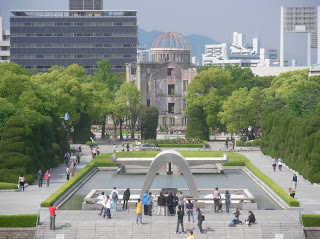
While I happily wandered around taking pictures of everything that moved and searching for the best angle to take a picture of the memorial, this young business man turned up, knelt, prayed and left.
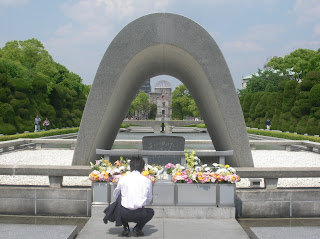
I quickly left myself, feeling a little ashamed after realising that this city was essentially a giant tomb where living relations of bomb victims still resided and not solely a tourist 'attraction'.
If the dome and the children's memorial hadn't been harrowing enough, the museum was even worse.
There were plenty of practical exhibits, mapping the destruction in relation to the bomb's going off point for example.
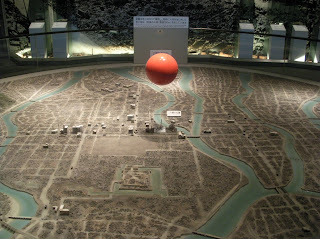
And there were lots of refreshingly honest explanations about the Japanese's actions during the war. But while there was no attempt to gloss over the failings of Japanese militarism, there was also no attempt to gloss over the American's motives for dropping the bomb.
Foolishly, for years I'd believed that in their desperation to end the fight-to-the-death war in the Pacific the Americans had dropped the bombs in a last ditch effort to bring it all to an end.
It is curious to know then that Hiroshima was chosen as a target because it had suffered little conventional bomb damage, unlike Tokyo. The reason this was important? So the Americans could truly assess the impact of a nuclear bomb on a populated and functioning city. That seems like the act of a calculating mind rather than a desperate one to me.
If the plan was to demonstrate to the Japanese the futility of continuing to fight while the Americans possessed this weapon, why not warn them and have the city evacuated or drop it on a rural area? Because the Americans wanted to end the war before the Russians were able to occupy a weakened Japan, which was only a few hundred miles off the coast of the Soviet Union.
So the destruction of Hiroshima was actually the first move in the political chess game that would become the Cold War.
I'm sure I'm being naive, but killing 140,000 people seems a pretty extreme way to prove political points?
In fact I know I'm being naive, war was ever thus, but it really hits home when you read letters from Manhattan Project scientists pleading with Truman not to use the bomb on a populated city.
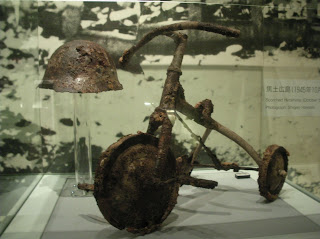
And wandering around the museum you can see why. I hadn't realised, but it wasn't the explosive effect of the bomb that did so much damage, more the 'heat ray' as they call it - the hugely intense wave of heat that swept the city burning everything in its wake. It's terrible to see the children's clothes and toys displayed in the museum.

The worst exhibit for me was actually a pretty crude wax depiction of a mother and child wandering through the city in the immediate aftermath, flesh and clothes dripping off them.
It was certainly gruesome. And when you know that there are only half a dozen photographs of the city immediately after the bomb fell because the one news photographer who was there was too traumatised to take pictures, you can get an idea of just how awful the scene must have been.
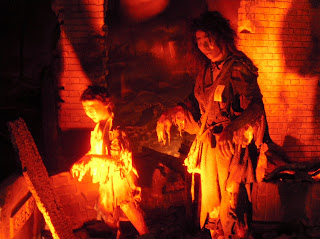
There are lots of other macabre exhibits in the museum and the curators in no way feel the need to spare your feelings.
This hair, for example, was brushed out of a victim's head a few weeks after the bomb was dropped, loosened by the radiation. She was soon dead of course.

The real tragedy of Hiroshima for me though was how irrelevant it now is. The museum is chock full of images of Reagan and the Pope (the nice Polish one, not the nasty German one) and crying school children singing for peace in the 1980s.
During the Cold War nuclear weapons were the stuff of nightmares, literally in my Mum's case. And I'm old enough to remember the fear of nuclear war. Hiroshima, understandably, rebuilt itself as a symbol of peace. Everything in the city is about peace and calls for a ban on nuclear weapons.
But the world has moved on. I'm not afraid of nuclear bombs in the way I was 25 years ago. CND and other organisations are virtually unknown to the modern generation. We have other things to be afraid of now.
In a way then Hiroshima has succeeded in its self-appointed role as a global warning against nuclear armament - as its rebuilders intended. But that whole raison d'etre is no longer relevant.
The reality for me though, walking around this place, was just sorrow. What a sad waste of lives.
A symbol of peace? Yes, but really, now, just a provincial city in Japan that happened to have a small nuclear bomb dropped on it because of the 12 cities the Americans chose as potential targets the clouds parted over this one on a particular day in 1945 and the bombers could see it. And 140,000 people died instantly in the closest thing to a hell on earth human beings have ever created.
How sad.
Well, enough of that.
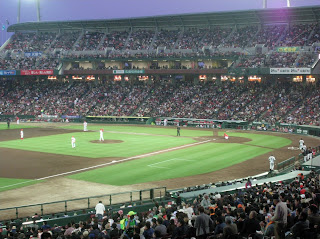
To cheer ourselves up we went to a baseball game that evening. Old and the new and all that.
As you know, I'm trying to get to a sporting event in every country I go to and as we'd missed the sumo it had to be besu-beru. I'm not sure Jude was that keen though!

I think she quite enjoyed it in the end though. It's hard not to enjoy 30,000 Japanese bouncing up and down to cheer a sport neither of us really understand.
After a pretty intense week of travelling around we decided to spend the last half of our time in Japan based in Hiroshima and using it as a base to explore other places in the region.
First up was Miyajama - another of Japan's top three most beautiful places. I'm not sure where the third was, but two out of three isn't bad.
Miyajima is actually an island just off the coast of Hiroshima and it is undeniably beautiful, particularly as you approach it from the sea.
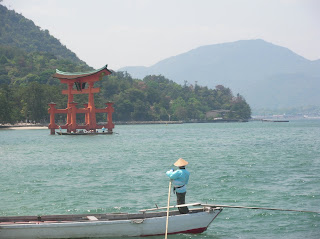
The red gates are the entrances to shrines and are there to guide the gods to their house (the shrine), and because the whole of Miyajima is a holy place the gate is out in the middle of the sea.
Similarly, the main island shrine is on stilts in the water. Beautiful.
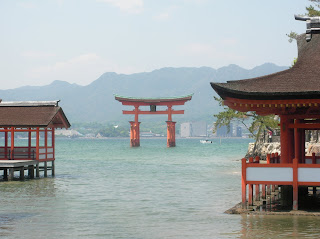
As beautiful as the shrine (yet another World Heritage site apparently) was, the main point of Miyajima is the mountain behind the shrine.
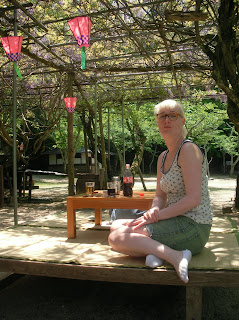
It seemed like most of the toursits were staying on the shore by the shrine so when we found a lovely little cafe nestling at the foot of the mountain, we had it pretty much to ourselves.
We caught a cable car up to near the peak of the mountain and set about hiking to the peak we'd spied from the cable carnand said 'That's too far, we're not going up there.'
Very surprised with ourselves and huffing and puffing like the pair of city-dwellers we are we climbed through the most wonderful scenery and little mountain paths, eventually being rewarded with a little shrine.
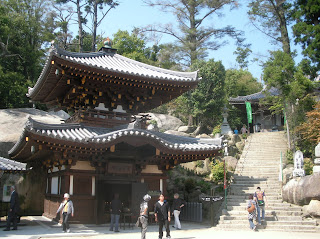
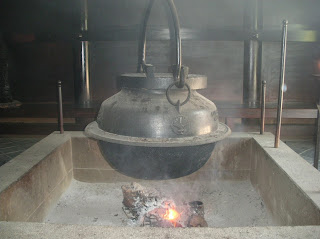
containing a flame which had been alight for a thousand years.
Another few hundred feet up, along more crazy paths, this time through some rocks,
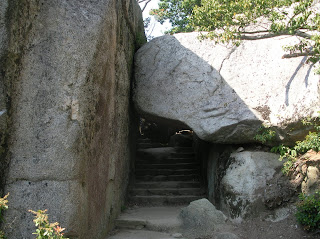
we got to the peak.
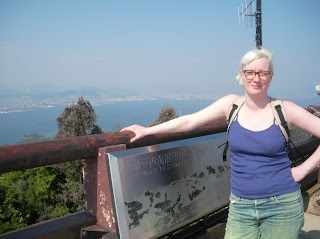
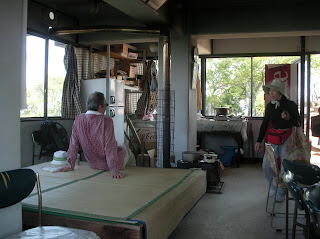
Where we had a coffee at the least pretentious tourist cafe we'd found in all Japan.
We spent most of our time there wondering how the hell the owner got his stock up there!
As knackering as the hike to the top had been, it was nothing compared to what was to come.
We'd cleverly thought the walk down the mountain would be easy so we only bought a one-way ticket on the cable care. Little did we realise though that the 6.5km path down from the peak was mostly stairs.

We were walking down through an amazing landscape, all myths and legends and caves and beauty, but we were still walking down a three-mile long staircase. I know it sounds easy, but after the first half an hour your knees and calves and thighs really begin to hurt. Alot.
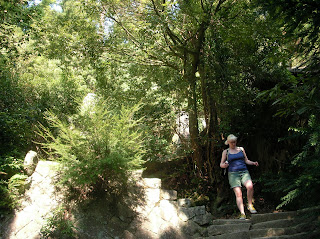
It's no joke, we were praying for the end of the path. It was agony at the time, but nothing compared to the next three days as muscles designed solely for climbing down stairs reminded us that they existed for the first time in our lives.
Scarily, we met a little old lady going up what had destroyed us coming down. Suitably ashamed I was determined to enjoy the shrine at the end of the path, even though this staircase greeted me. Bugger.
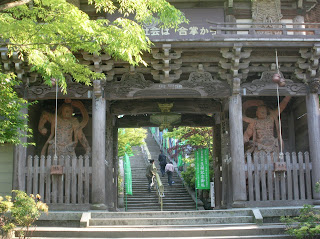
I'm glad I made the effort though as it was one of the most beautiful shrines of the many I'd seen in Japan.
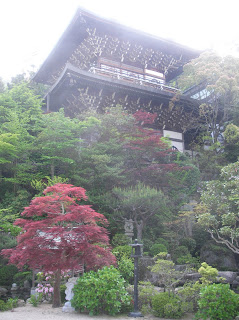
Particularly the little lily ponds, water gardens and tiny Buddhas.

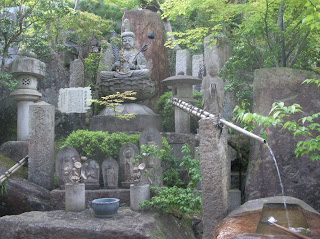
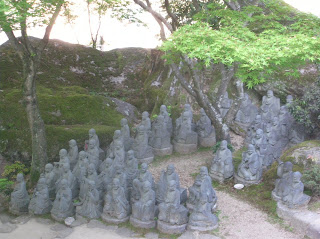
The next trip was originally planned to be to a small town in the hills called Hagi, famous for its samurai village.
I'd like to think we missed the bus because the Shinkansen was late, but it was probably because after our tramp down the mountain in Miyajima we could barely walk. Seriously, we looked like cripples.
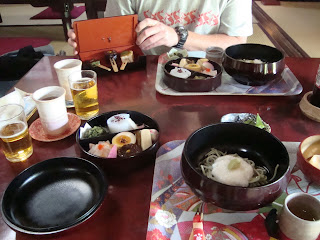
So we took an on-the-spot decision to visit Tsuwano, a tiny little town in the mountains where they served kaiseki - Japanese haute cuisine.
We'd read about kaiseki when we were in Kyoto and it sounded delightful - local, seasonal food served in typically Japanese surroundings, which are apparently as important as the food.
And the surroundings were certainly delightful.


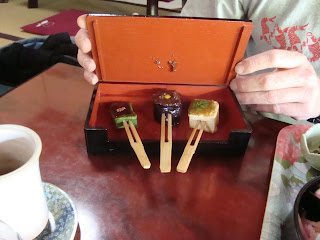
In fact, it was probably the most pictaresque restaurant I've had the pleasure to squat in. But the food was more of a challenge. It turns out kaiseki bore no resemblance to any kind of food I've seen anywhere in the world, ever. It was completely unidentifiable by sight, taste or texture. Incredible.
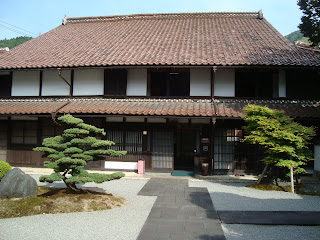
After lunch we strolled through the village and we stumbled across this beautiful little house, which actually turned out to be an art gallery.
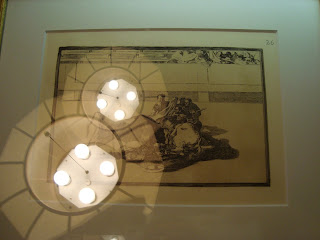
I'm tempted to say the highlight was the collection of 30-plus Goya sketches they had (which was incredible enough in itself).
But actually, the lady who gave us a comprehensive tour of the building was the highlight. It was abvious we didn't speak any Japanese whatsoever, but she still perservered giving us the whole spiel in Japanese for a good half an hour. Bless her.
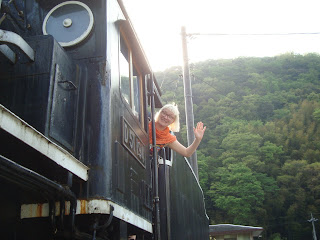
Aside from the gallery and the restaurant there wasn't a great deal else in Tsuwano, so we whiled away an hour eating ice-cream and playing on the old steam train they had in the station car park.
It had actually taken us three hours to get to Tsuwano from Hiroshima and even Jude was bored of my witty conversation on the way home. Six hours in a train carriage with me is a long time for anyone!
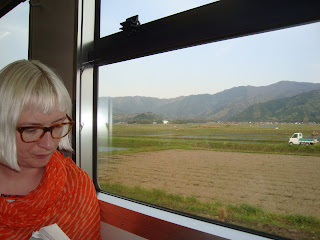
That evening we treated ourselves to a night on the town as Jude was going to be leaving soon.
We'd tried kaiseki so we thought we'd continue the culinary experiments by trying okonomiyaki - or cabbage pancakes as I'd always referred to them when I'd seen them being cooked on the streets.
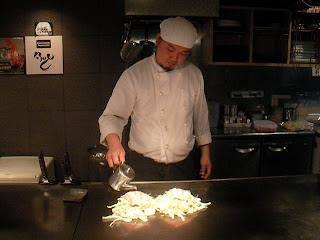
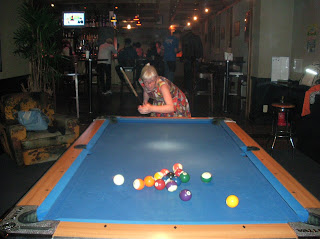
Pretty good though, and we had fun in a pachinko parlour and a downtown Hiroshima gai-jin bar afterwards.
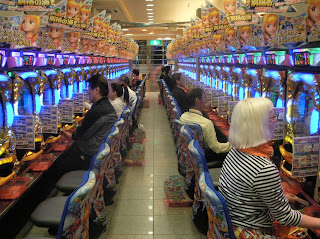
Pachinko had been on my itinerary since I arrived in Japan, but I can honestly say, despite my best intentions, I did not have a clue what it was about.
Watching ballbearings drop down through a pattern of pins in the hope of catching enough in the right hole to win? No thanks. And that description makes it sound more interesting than it really is. Really.
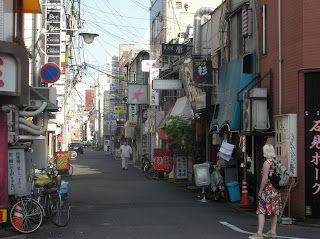
Our last day in Hiroshima was spent wandering the streets and soaking up Hiroshima life.

Until eventually we wandered upon Hiroshima castle. For obvious reasons it was not the original, but it was still pretty impressive in its restored form.

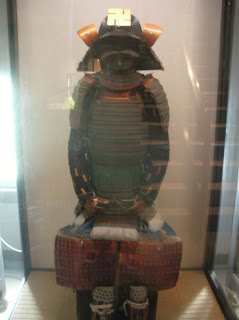
And inside was a treasure trove of cool weaponry and military history. Inclusding this nazi samurai outfit
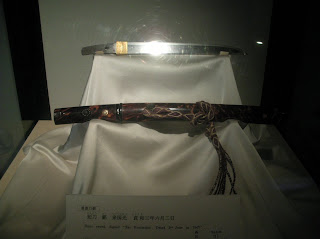
and this samurai sword from the 14th century. I knew it was that old because every sword in the museum had been signed by the swordsmith on its handle. I was gobsmacked at the age of this one - the blade still looked razor sharp.
We strolled around the gardens, conscious that they were the barracks for the soldiers that made Hiroshima a military target in 1945 - 10,000 men died beneath our feet - and came across this eucalyptus tree.

Apparently it lived through the bomb. Everywhere else around this solitary tree was razed to the ground, but somehow it lived on. Much like Hiroshima itself.


